
Last updated: November 6, 2026
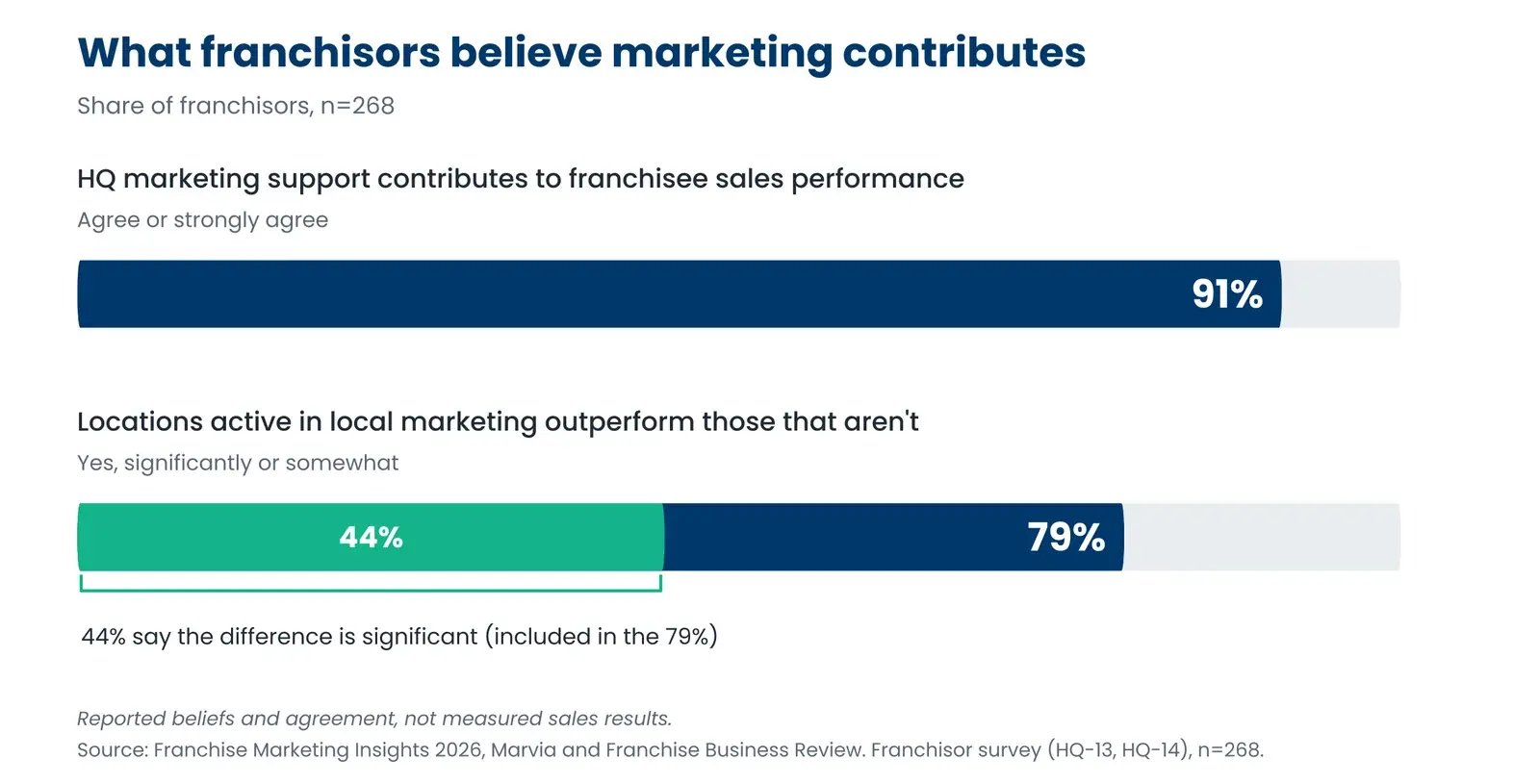
If franchise HQ teams voted on whether local marketing drives sales, it wouldn't be close. In the 2026 Franchise Marketing Insights survey, 91% of franchisors said HQ's marketing support contributes to franchisee sales.
So the short answer to the question posed in the headline is yes, at least according to the people running franchise systems. I'd argue that's the less interesting question, though. Inside HQ, it's mostly settled.
The question I'd spend time on is whether the owner running a single location believes it too. That's the person deciding, week after week, whether marketing deserves an hour they could spend on the floor. And the data says a lot of them aren't sold.
What does the data say about local marketing and franchise sales?
Franchisors are about as unified on this as survey respondents get. 91% of franchisors agree or strongly agree that the marketing support HQ provides contributes to franchisee sales performance. And when asked about local marketing specifically, 79% of franchisors believe locations that actively participate in local marketing outperform locations that don't, with 44% saying the difference is significant.
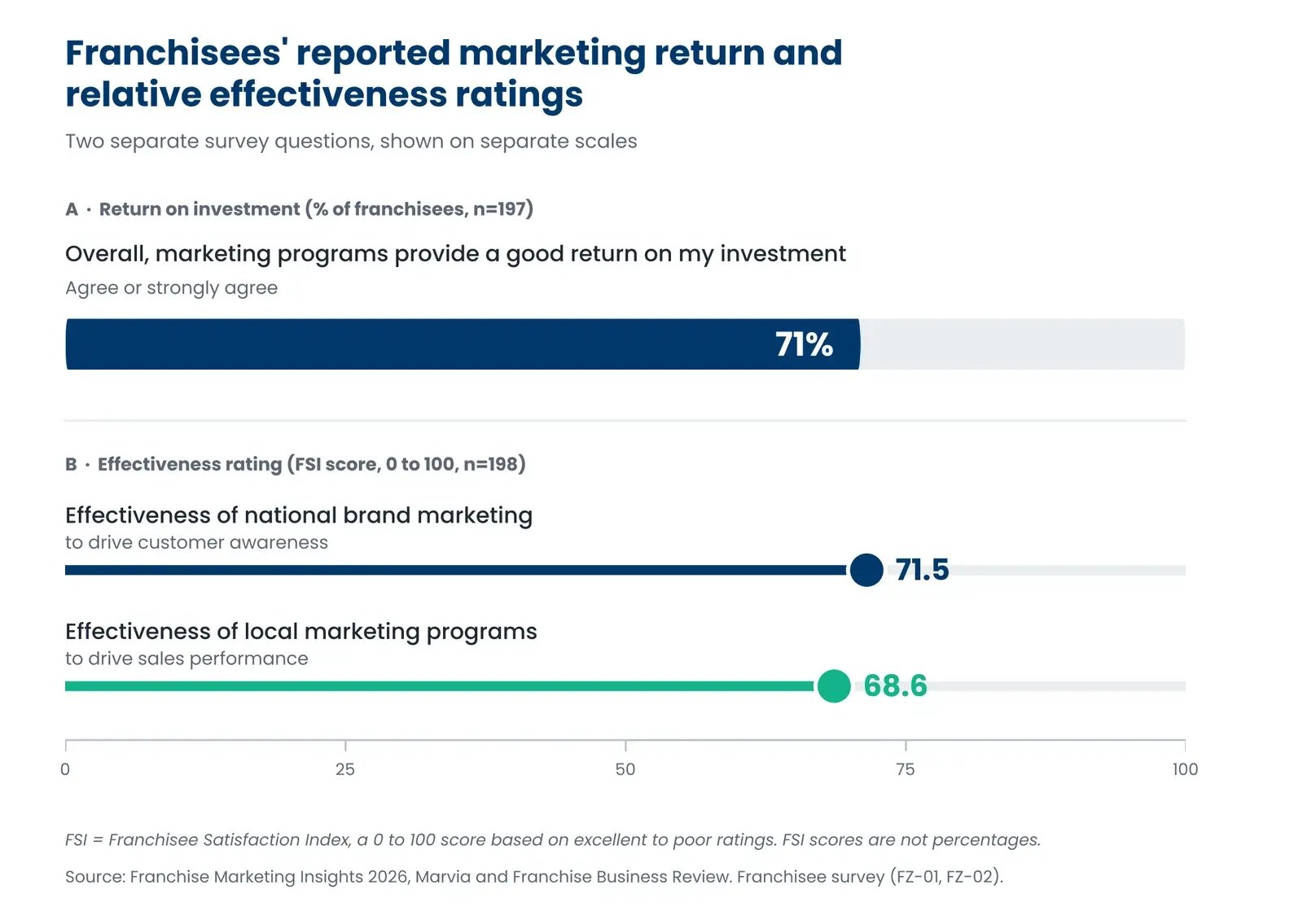
Franchisees are positive too, just less emphatic. 71% of franchisees agree or strongly agree that the marketing programs provide a good return on their investment. They gave national brand marketing an FSI of 71.5 for driving customer awareness and local marketing programs an FSI of 68.6 for driving sales performance. FSI is Franchise Business Review's Franchisee Satisfaction Index, a 0 to 100 score.
Where franchisee confidence drops off
That 71% is an average, and averages hide things. Split franchisees by how many locations they own and the picture changes fast.
Single-unit owners are the least satisfied group in the entire dataset. They rate marketing support 10 to 28 points lower than multi-unit operators on nearly every measure. On good ROI, it's 52 for single-unit owners vs. 76 for multi-unit. On national marketing effectiveness, it's 48 vs. 76.
Their behavior lines up with those scores. 20% of single-unit owners spend less than an hour a week on local marketing, compared with 2% of multi-unit operators. When single-unit owners do go around HQ, it's mostly because materials don't fit their market (35%) or feel impersonal (26%).
The report's read is that this group has largely disengaged from a system that wasn't designed for them, rather than lost interest in marketing. Add in reporting that franchisees say focuses on reach and impressions instead of leads, visits, or revenue, and it's easy to see why the belief at HQ doesn't always make it to the front counter.
Why don't more franchisees buy into local marketing?
Here's how I read it. HQ has a belief about its network. Franchisees are being asked to act on that belief with their own hours and their own money. Those are very different levels of commitment.
Local marketing also asks more of a franchisee than national marketing does. National awareness happens around them. A local campaign needs them to pick the offer, post the content, brief the staff, and keep an eye on results. So it gets judged on the hardest outcome to prove, which is sales. I don't read the small gap between those two FSI scores as local marketing falling short. I read it as local marketing being held to a tougher bar and still scoring close.
Now put yourself in a single-unit owner's shoes. You've got the least amount of time in the system, materials that often don't fit your market, and reports that show impressions instead of customers. Giving up an hour a week for marketing you can't see working feels like a bad trade. Disengaging is a pretty rational response.
That's why I don't think more encouragement from HQ will close this gap. Proof will. And HQ is probably closer to having it than it realizes. You don't get 79% of franchisors saying participating locations outperform unless a lot of them think the evidence is out there in their own data. The opportunity is pulling that evidence together and putting it in front of the owners who haven't seen it yet.
How can franchise brands prove local marketing works to their own franchisees?
Think of this as running a campaign for local marketing itself, aimed at your own network. The audience is skeptical, short on time, and only moved by results they recognize.
-
Test your own 79%. Pick a recent campaign or a full quarter. Compare locations that ran local marketing with similar locations that didn't, using whatever outcome data you already have: sales, transactions, bookings, leads. Group them by size, market, or volume so the comparison feels fair to the people looking at it.
-
Talk in franchisee numbers. Franchisees want leads, visits, and revenue, so lead with those. Reach and impressions can sit underneath as supporting detail. The report's advice here is practical: start by sharing the location-level data many systems already collect but don't pass back to franchisees.
-
Let peers make the case. A network-wide average is easy to dismiss. A location that looks like yours, in a market like yours, getting results from a campaign you skipped is a lot harder to ignore. With permission, share comparisons between similar locations, and invite the owners behind the strong results to talk about what they did.
-
Make trying it cheap. Proof only helps if acting on it is easy. The report points out that single-unit operators get the most out of ready-to-use campaigns, clear guidance, and simple execution. If a local campaign takes a single-unit owner 15 minutes instead of three hours, the bar for giving it a shot drops a lot.
-
Build the next round of proof into every campaign. Give each local campaign one clear goal and bake in the tracking before launch, like a location-specific offer code or link. That way the next comparison is easier to run, and the evidence keeps building.
How this works in practice
Picture the marketing lead at a quick-service brand with a mix of single-unit and multi-unit owners. Last spring, HQ offered a local weekday lunch promotion. Plenty of multi-unit operators ran it. A lot of single-unit owners didn't.
This year, before pitching the next local campaign, she pulls the numbers. Each participating store had its own offer code, so she can see redemptions by location. She lines those stores up against similar stores that skipped it and looks at weekday lunch transactions over the same eight weeks.
At the spring franchisee meeting, she doesn't open with reach. She shows a one-page view: what participating stores saw, next to comparable stores that sat it out. She keeps the framing honest, as a comparison and not a promise. Then she hands the mic to a single-unit owner who ran the promotion, so the rest of the room hears it from someone in their position.
The next campaign ships ready to run. Brand elements are locked, and owners only fill in their hours, a local photo, and the offer end date. The posts are pre-written for the channels franchisees say work best for them, like email, paid social, and organic social.
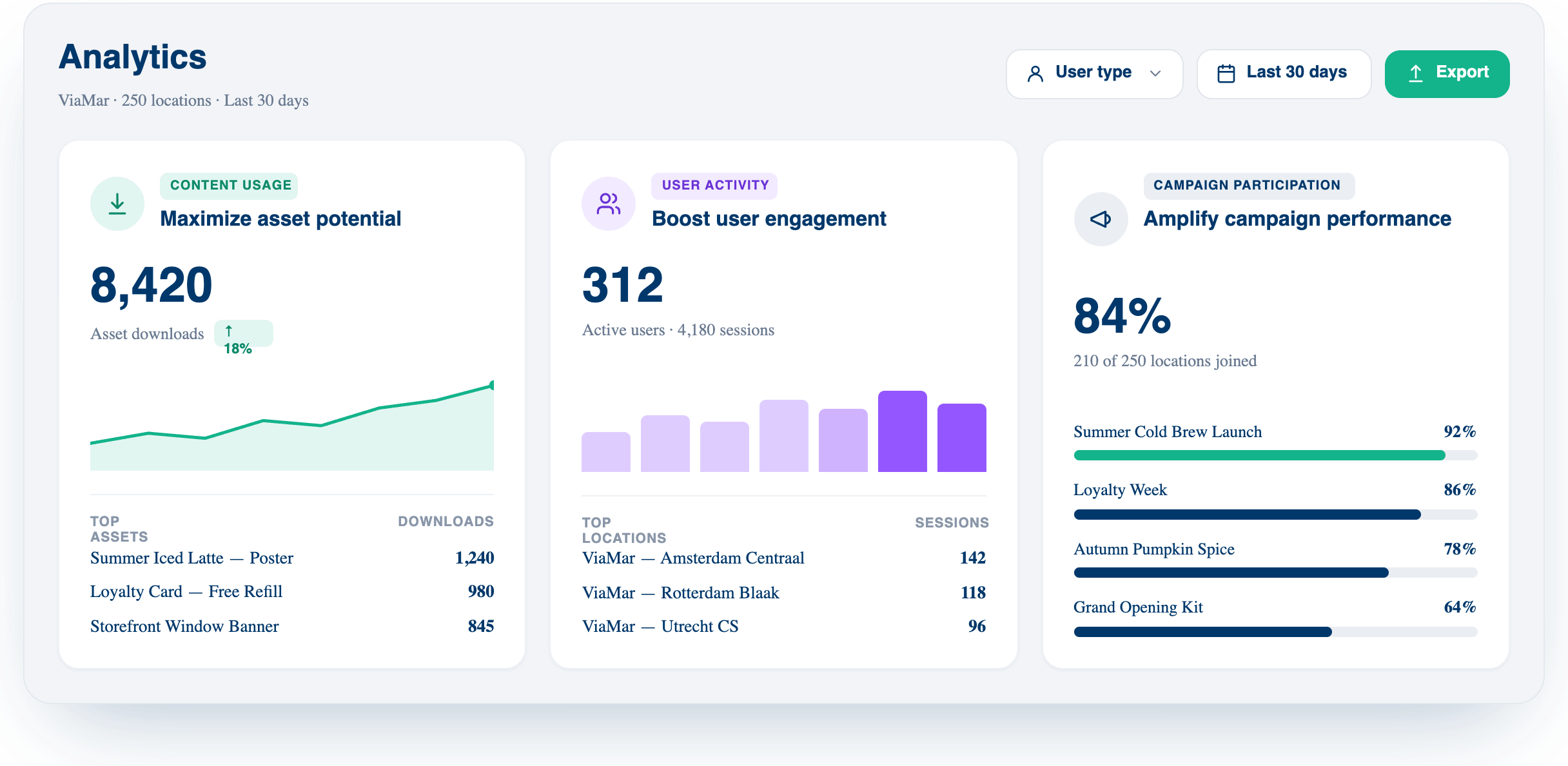
This is the loop we built Marvia to support. HQ can publish a campaign as a template that's quick for locations to customize, then use Marvia Analytics to see which locations used it and how they performed. You could piece the same loop together with other tools. The part that matters is having participation and results in one place, so the proof is ready when it's time to make the case again.
Local marketing drives sales when franchisees can see it
Ask franchisors whether local marketing drives sales and you'll get a resounding yes. That belief is worth a lot, but it only pays off when franchisees act on it, and the owners with the least time and the weakest results are the ones still waiting to see it.
So spend less energy convincing your own team and more on showing your network. Compare participating and non-participating locations, report in the numbers franchisees care about, let similar locations tell the story, and make the next campaign easy enough to try. The brands that do this well will have something better than a confident survey answer. They'll have their own franchisees making the case for them.
Read the Franchise Marketing Insights 2026 report. For a discussion of the findings and practical next steps, register for the November 10 webinar.