
The campaign pack went out on a Tuesday. Forty-eight hours later, a dealer in Kansas City emailed asking if you had "anything they could use locally." You had just sent them fourteen assets.
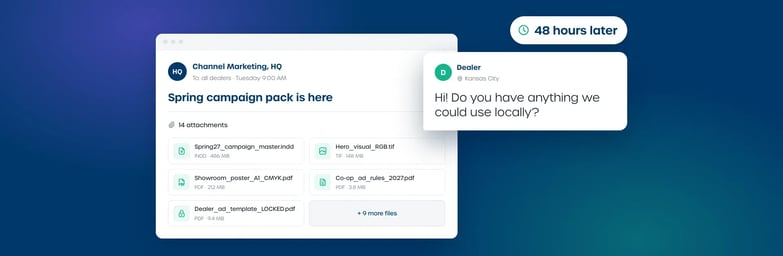
This is one of those situations that feels like a dealer problem but almost never is. The materials existed. The dealer just could not, or did not, use them. And if it happened in Kansas City, it probably happened in Minneapolis, Denver, and Portland too.
The good news is that dealer disengagement from HQ materials is predictable. The reasons are almost always the same, and so are the fixes.
Reason one: they cannot find what they need
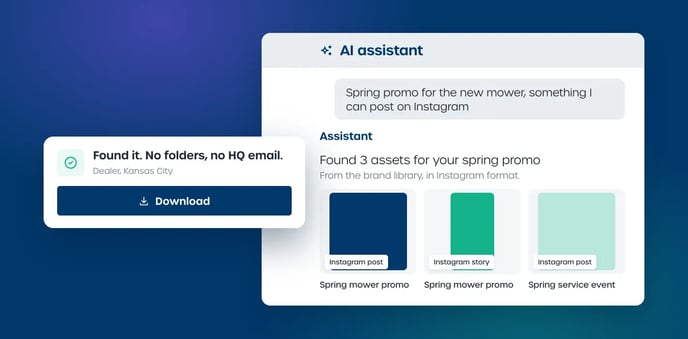
Most asset libraries are organized around how the central team thinks about products, not how a dealer thinks about their next promotion. A dealer running a spring campaign for one product line in one local market does not want to browse through folders organized by campaign year, then product category, then region, then file type.
They want to find the right thing in thirty seconds or give up and move on.
What good looks like: dealers can search by product, campaign, format, or season and land on the right asset immediately. The library is built around their workflow, not the central team's folder structure.
Reason two: the materials are not ready to use
A master InDesign file is not a usable asset for a dealer who does not have InDesign. A high-resolution print file sent to a dealer who needs a social post is not useful either. Neither is a template locked down so tightly that a dealer cannot add their own address, logo, or a local promotion without requesting a custom version from HQ.
Central teams often send what they have rather than what dealers can actually use. The gap between "we sent it" and "they can use it" is where most local activation dies.
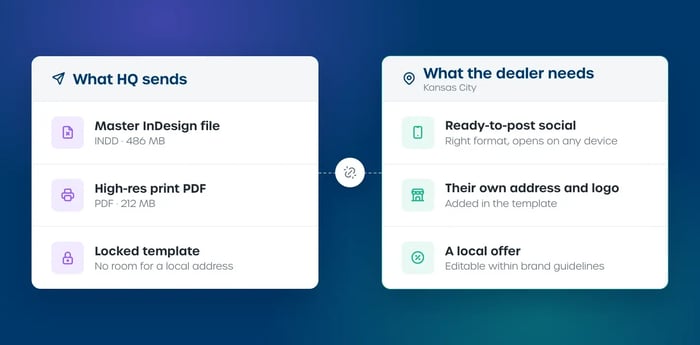
What good looks like: assets arrive in formats dealers can open, edit within brand guidelines, and use immediately. Customization (logo, address, local offer) is built into the template, so dealers never need to go back to HQ for a custom version.
Reason three: your brand is not their only priority
This one is easy to overlook from HQ. Your dealers carry multiple brands. They have their own business to run, their own customers to manage, their own margins to protect. Your campaign is one of several landing in their inbox this month, and they are deciding where to spend their time.
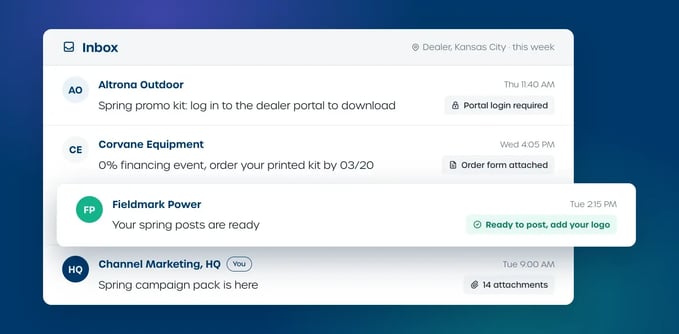
If using your materials takes meaningful effort, and a competitor's materials are ready to go, the competitor wins that dealer's attention. Not because your brand is less important to them, but because time is finite and the path of least resistance wins.
What good looks like: activating your brand locally takes less time and effort than activating any alternative. That is the bar. Not perfect brand compliance, but real ease of use.
Reason four: they have had bad experiences before
Dealers have long memories. If the last time they tried to use HQ materials they got a file that would not open, a template that would not print correctly, or a request that sat in someone's inbox for two weeks, they stopped trying. That experience becomes the assumption.
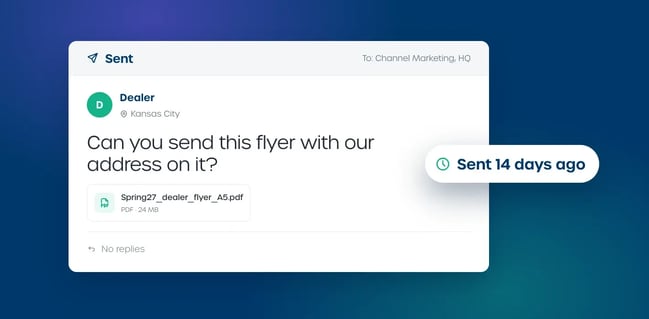
It only takes a few frustrating interactions to train a dealer out of engaging with your marketing support entirely. And once they have stopped, re-engaging them takes more than a new asset pack.
What good looks like: the experience of getting and using materials is consistently smooth. When something goes wrong, it is fixed quickly. Dealers who have a good experience tell other dealers. Trust erodes fast and rebuilds slowly.
Reason five: nobody ever showed them what was available
A lot of manufacturers assume that sending an email with a link to the asset portal counts as onboarding. It does not. Dealers are not marketers. They do not spend time exploring what HQ has built for them. They respond to specific, timely prompts: here is what you can use right now, for this campaign, in this format.
If dealers do not know what is available or how to use it, they default to doing nothing or doing something off-brand that at least feels manageable.
What good looks like: dealers get proactive communication about what is available and when. Not a monthly newsletter, but specific, actionable prompts tied to campaigns or seasons that make it obvious what to do next.
What this looks like when it works
Style de Vie, a kitchenware wholesaler supplying cooking and gift shops across Benelux, faced a version of this problem as it expanded into new European markets and North America. Its answer was a branded portal with over 2,400 assets (product photos, videos, logos, brochures, and campaign materials) that resellers across all its brands could browse and download themselves, without going back to HQ.
"The intuitive folder structure enables our customers to navigate effortlessly through the image bank," said Kevin Vollebregt, Marketing Manager at Style de Vie.
The portal also showed the team which assets resellers were reaching for, which they planned to use to shape future photo shoots. That is the part most HQ teams miss: making materials available is step one. Learning what dealers actually use is what makes the next campaign better.
Questions worth asking internally
Before assuming your dealers are disengaged, run a quick internal audit. These questions tend to surface where the real problem sits.
These are not complicated questions. But the answers tend to be more honest than a dealer survey.
A practical starting point
The five reasons above are not hypothetical. They show up in almost every manufacturer network we speak to, usually in combination, and usually quietly enough that nobody has flagged them as the reason local activation is low.
The dealer activation score quiz is a good way to find out which ones apply to yours. It takes about five minutes and gives you a specific picture of where dealers are hitting walls, rather than a general sense that something is not working.
That specificity matters. Because the fix for "dealers cannot find what they need" looks very different from the fix for "dealers had a bad experience and stopped trying." Knowing which problem you are actually dealing with is what makes progress possible.