
This article is part of a series exploring the Franchise Marketing Insights 2026 research conducted by Franchise Business Review in partnership with Marvia. The series uses the survey data to examine what the findings may mean for franchise marketing teams.
Key takeaway: When a franchisee creates their own marketing materials outside of what HQ provides, the content itself tells only part of the story. The reason may be local fit, a more personal voice, or not knowing an approved option existed in the first place. Each points toward a different conversation.
When a location creates its own content, the conversation can quickly center on the finished piece. A more useful starting point is why the franchisee made it in the first place.
One franchisee may change a national campaign because it misses something about the local market. Another may keep the message but make it sound more like the people who work there. Some may not know HQ already has material for the campaign. The same label, “created their own content,” covers different needs.
The reason changes what the behavior means
The Franchise Marketing Insights survey data points to several distinct motives. 29% of franchisees have created their own marketing content because HQ materials didn't fit their local market. That’s a direct signal about local relevance. A campaign can follow the brand and still miss a local offer, audience, or context. When franchisees change it to make the message work in their market, HQ has a chance to learn what the central version left out.
24% of franchisees have created their own marketing content because they wanted something more personal. That’s a different kind of request. The franchisee may not be trying to change the brand’s promise. They may want the message to sound less distant from the customers they know. A local photo, a staff member’s voice, or a familiar phrase can make a national idea feel present in a real community. Brand consistency doesn’t require identical wording in every location. It requires that local expressions still feel like the same brand.
9% of franchisees have created their own marketing content because they didn't know HQ materials existed. In those cases, the content isn’t a deliberate rejection of central marketing. The franchisee may have been acting without knowing an approved option was available or where to find it. That’s a different conversation from a location knowingly changing a required claim or brand element.
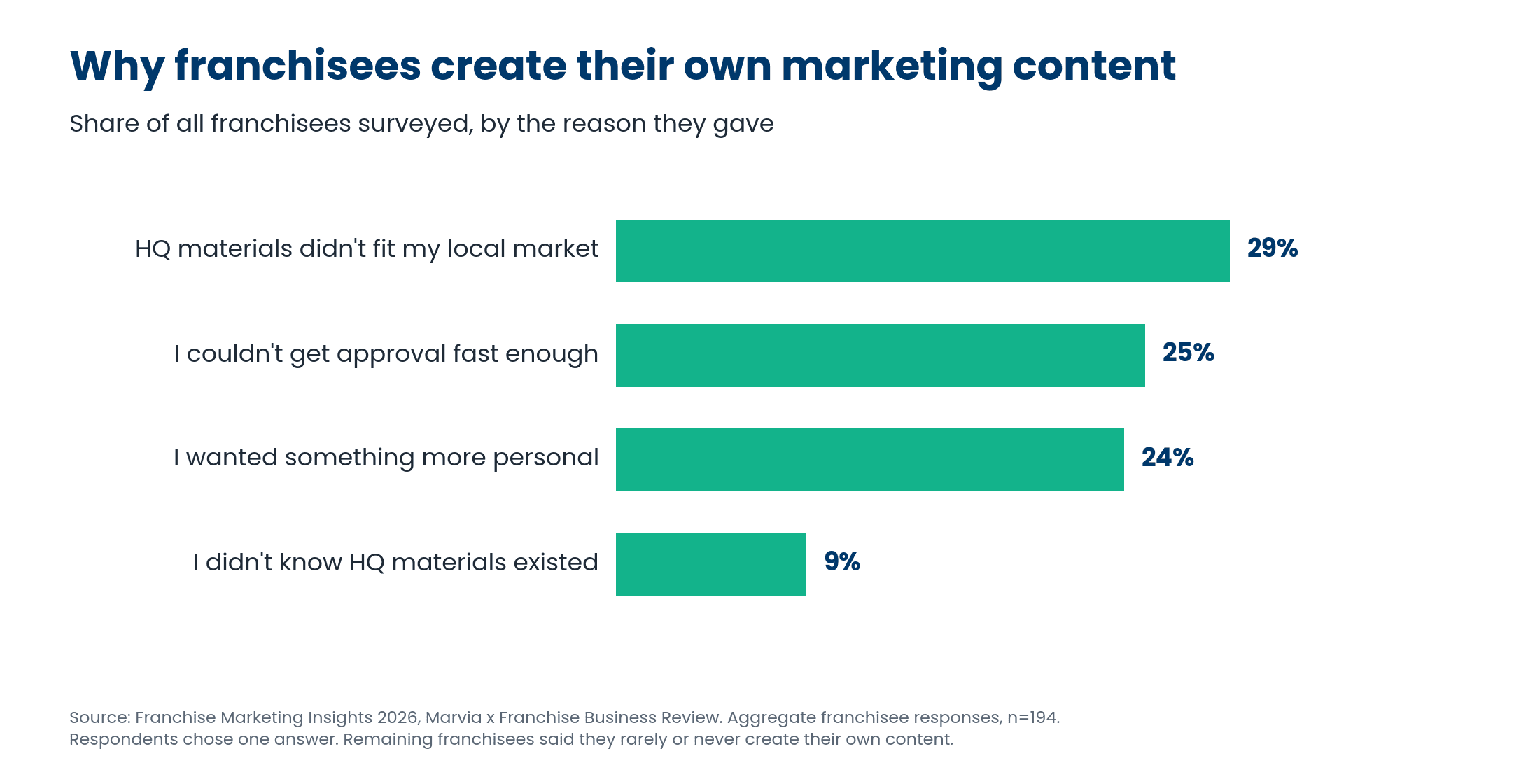
These numbers don’t describe every reason a franchisee might make content. But they do show why HQ shouldn’t treat every locally created asset as the same kind of problem. A market-fit issue, a desire for a more personal voice, and an awareness gap point in different directions.
Why HQ should pay attention
Franchisees are close to the people and local context the central team may not see. Their choices can show how a brand is being interpreted where customers actually encounter it. When a franchisee adds local context or rewrites a line to sound more personal, HQ can learn something about the gap between the national message and the local conversation.
This isn’t a case for approving every piece of content. A change that affects a required claim still deserves a different response than a warmer caption or a local detail. But treating all of it as a compliance issue can hide useful feedback about how the brand reaches people in different markets.
Why this matters
HQ is responsible for the brand and local partners are responsible for their local communities. Both parties are trying to make the brand relevant to their customers. Swapping in an approved local image, adding event details, or adapting a caption to sound natural can be exactly what a solid brand template is designed to support.

The survey finding is about a narrower behavior: franchisees creating content outside the materials HQ provided. That shouldn’t be treated as proof of a brand problem. But when locations build something independently, it’s worth asking whether the approved materials gave them a useful starting point and enough room to adapt it.
Consider two cases. One location uses an approved template and swaps in a local photo or event detail. That’s the system working as intended. Another creates a new asset because no available template fits the offer, audience, or moment. That points to a gap HQ can address by adding a useful option or building more flexibility into the campaign. In either case, the local team is trying to connect the brand to its market; the difference is whether the tools support that work.
So start with what the team needed, what the approved materials allowed, and what made them choose a different route. That gives HQ a clearer basis for deciding whether to expand the options, make them easier to find, or step in because a required claim or brand element has changed. The goal isn’t to reduce localization or review every variation. It’s to make the approved system work for the day-to-day task of adapting marketing to a community.
Build that room into the campaign from the start. Give locations a strong central idea and practical ways to customize the details that matter locally, such as images, events, offers, and community context. Not every campaign needs a dozen versions, but local teams shouldn’t have to start from scratch to make the work feel at home in their market.
How this works in practice
Franchisee-created content isn’t a verdict on the brand or the standards HQ has set. It’s a clue about how local teams are trying to make local marketing work. Finding the reason behind it tells HQ whether the gap is relevance, voice, or awareness.
That’s why HQ should pay attention. When you look beyond who made the file, you can find more relevant information about the brand’s local presence, and use that understanding to make future marketing feel more connected to the people it serves.
Read the Franchise Marketing Insights 2026 report. For a discussion of the findings and practical next steps, register for the November 10 webinar.