
This article is part of a series exploring the Franchise Marketing Insights 2026 research conducted by Franchise Business Review in partnership with Marvia. The series uses the survey data to examine what the findings may mean for franchise marketing teams.
Most franchisors have found locations using off-brand or unapproved content. At the same time, many HQ teams feel confident that local marketing is staying on-brand. The tension points to a visibility problem: central teams need a clearer view of what locations use, where they work around HQ, and why.
Brand consistency is harder to see than to define
Most franchise marketing teams know what on-brand execution should look like. The guidelines are documented. Approved assets exist. Campaigns are built centrally and distributed across the network.
The difficult part is knowing what happens after those materials leave HQ. A local team may use the approved social post, customize a campaign template, or request an asset from the central team. Another location may pull an old file from a shared drive, adjust a national campaign in a design tool, or create something from scratch because the approved option doesn't fit its market.
HQ may only see the result when someone spots it in the wild. That makes brand consistency more than a standards problem. It's also a visibility problem.
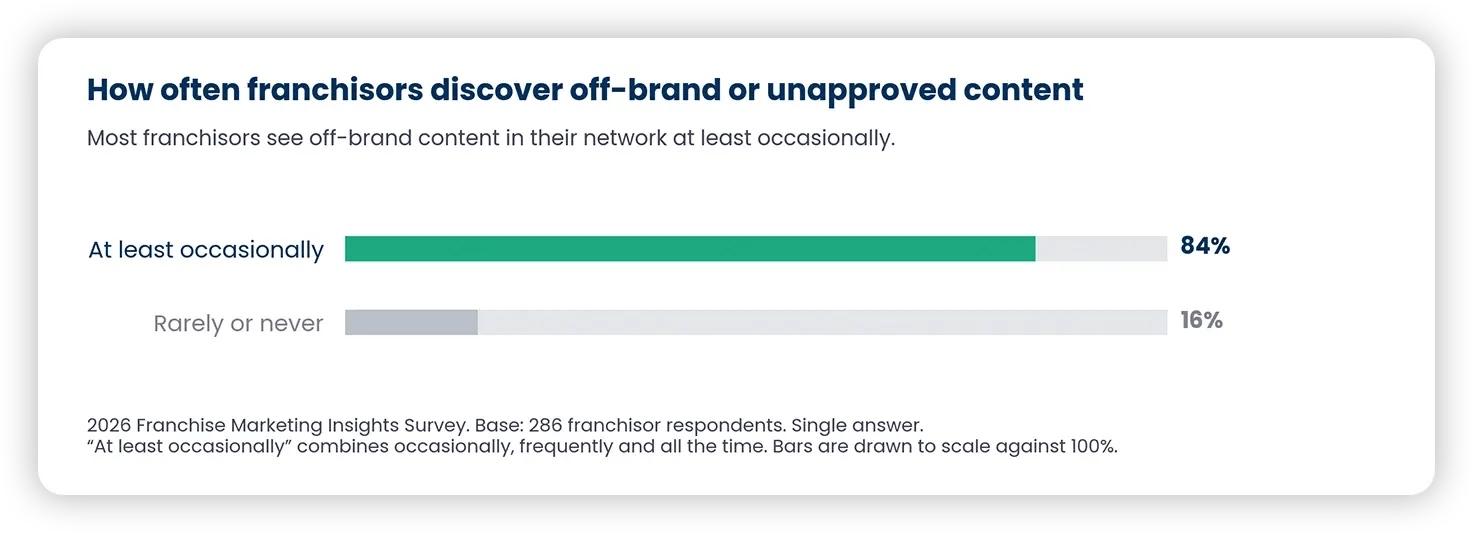
Off-brand content is part of normal franchise marketing operations. The aggregate survey data shows how widespread the issue is. 84% of franchisors have found franchisees using off-brand or unapproved content. This figure includes franchisors who say they discover it occasionally, frequently, or all the time.
That doesn't mean every location is routinely ignoring brand standards. It does mean that off-brand content is not an isolated exception for most of the franchisor teams surveyed.
Confidence and observation can exist at the same time
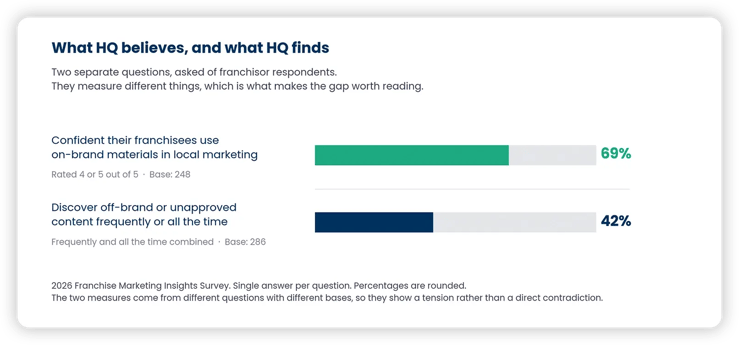
The research shows a second pattern that is harder to explain at first glance. 69% of franchisors report being confident or extremely confident that franchisees use on-brand materials. Yet 42% of those same franchisors say they discover off-brand or unapproved content frequently or constantly. These findings aren't mutually exclusive. A central team can have strong standards, provide useful materials, and see a large amount of on-brand activity while still discovering repeated exceptions.
The problem starts when confidence becomes a substitute for measurement. Confidence may reflect the quality of the materials HQ creates, the participation a team sees in official campaigns, or the belief that locations generally understand the brand. Discovery data captures something different: what central teams find when they look at local execution.
Together, the findings suggest that many HQ teams have a reasonable sense of whether the system is working, but not a complete view of how it works across every location and channel.
Many teams still don't track material usage formally
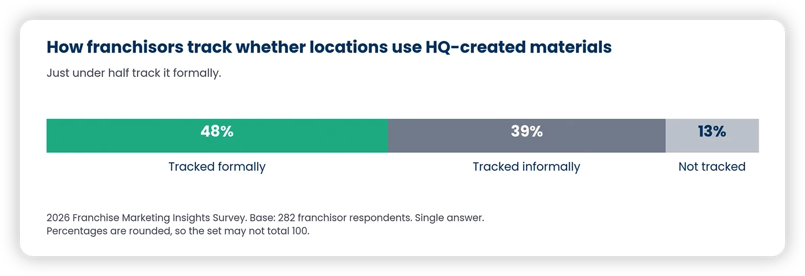
The survey also points to a basic measurement gap. 13% of franchisors say they do not track whether franchisees use the marketing materials they create. Among the teams that do track usage, 48% do so formally and 39% informally.
That leaves a large share of teams relying on partial signals. They may hear from field teams, notice requests coming into the inbox, review a few local channels, or look at campaign participation. Those signals can be useful, but they don't answer every important question:
- Which locations are using the current approved templates?
- Which campaigns are being ignored?
- Which materials are being customized most often?
- Where are locations creating content outside the system?
- Are they doing that because the material doesn't fit, because approval takes too long, or because they can't find the approved version?
A team that can't answer these questions may still have a strong brand program. It just doesn't have enough operating data to know where the program works well and where locations need a better path.
What the pattern suggests
The research doesn't prove that weak measurement causes off-brand content. It does show that confidence, off-brand discoveries, and limited usage tracking can coexist inside the same HQ organization. That changes how central teams should approach the problem.
The first response shouldn't be to treat every off-brand example as a compliance failure. It should be to understand the conditions behind the behavior. A location may be working outside the approved system because the right asset is difficult to find, the template doesn't leave room for local details, or the approval process doesn't match the pace of the market.
This doesn't excuse every off-brand execution. Brand standards still matter. It does give HQ a more useful starting point than assuming locations simply chose to ignore them.
Four ways to measure brand consistency more usefully
1. Track use, not just distribution
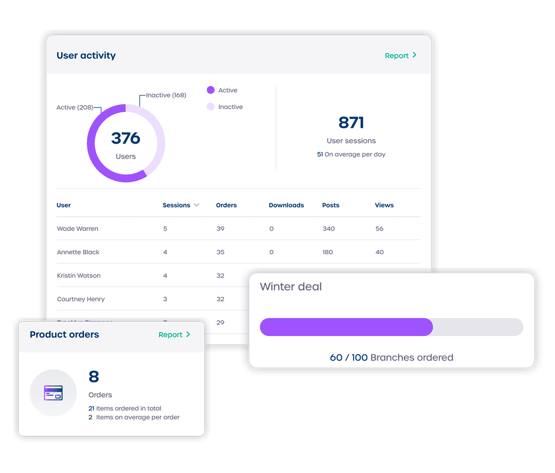
Sending a campaign to every location doesn't tell you whether anyone used it. Track template opens, completed assets, campaign participation, and activity by location. Distribution is an output. Usage gives you a better view of execution.
2. Record why locations leave the approved path
When a location creates its own content, record the reason. Group the findings by market fit, speed, personalization, awareness, missing materials, or another clear category. Repeated workarounds show where the system needs attention.
3. Compare confidence with behavior
Ask HQ teams how confident they are that local marketing stays on-brand, then compare that view with usage activity, approval requests, and off-brand findings. The goal isn't to prove someone wrong. It's to identify where perception and observed behavior differ.
4. Measure the friction around approved content
Brand consistency is affected by more than the content itself. Track how long it takes to find an asset, customize it, request an approval, and publish it. If the approved route takes too long, locations have a reason to find another route.
A practical brand consistency review
A monthly or quarterly review can bring these signals together. For each major campaign, central teams can look at:
- The percentage of locations that opened or used the campaign
- The templates and assets used most often
- The number and type of requests sent to HQ
- Average approval turnaround
- Locations creating content outside approved materials
- Common reasons for workarounds
- Performance or participation differences by location
This gives the central team a better way to decide what needs attention. A low-use template may need a better local offer. A high volume of requests may point to missing editable fields. Repeated off-brand examples may reveal that approved assets are difficult to find or too restrictive to use. The review should lead to changes in the system, not only a list of locations to correct.
The bottom line
The research points to a brand consistency problem that can't be understood through confidence alone. Most franchisors have found off-brand or unapproved content. Many still feel confident that locations use on-brand materials. A smaller group tracks usage formally, while others rely on informal signals or don't track it at all.
The practical next step is to measure what happens between distribution and execution. Which materials do locations use? Where do they need help? What makes them work around HQ?
Answering those questions gives central teams a better basis for improving brand consistency without making local marketing harder to execute.