Balancing brand consistency and local flexibility comes down to giving local teams a practical way to customize approved materials without turning the central team into a request queue. For most franchise brands and distributed organizations, that means combining centralized content management, editable templates, and approval workflows that keep marketing on-brand at scale.
Key takeaways: how to balance brand consistency and local flexibility
- Define what stays fixed
Lock down the brand elements local teams should never change, such as logos, core messaging, fonts, and required legal copy. - Centralize approved assets
Keep current materials, templates, and brand rules in one place so locations always know what to use. - Build editable templates for common requests
Turn repeat customization requests into self-service templates local teams can use on their own. - Set approval rules by risk level
Allow low-risk edits to move faster and route higher-risk changes through review. - Review request patterns regularly
Use repeated requests as a signal for which templates, permissions, or workflows need to improve next.
Most central teams don't have a brand problem, they have an execution problem. The challenge is rarely writing the guidelines. The challenge is applying them across dozens, hundreds, or even thousands of locations without slowing local teams down.
For franchise marketing managers and multi location brand marketers, that tension shows up every day. Local teams need room to customize materials for their own market. The central team needs confidence that what goes out still looks and sounds like the brand. When the process depends on email threads, shared folders, and one-off design requests, both sides lose time.
Why brand consistency and local flexibility feel like competing priorities
Central teams are responsible for protecting the brand across every location, campaign, and channel. Local teams are responsible for making that marketing usable in their market. Both goals are reasonable. The friction usually starts in the workflow.
A location needs to update a flyer with store details, swap in a local offer, or promote an event that only matters in one market. The central team wants to protect logos, fonts, messaging, legal language, and campaign structure. When each update turns into a manual request, small edits pile up quickly.
That usually creates the same pattern:
-
Local teams wait too long for simple updates.
-
Central teams spend their week handling repeat customization requests.
-
Approved assets go unused because they are too hard to adapt.
-
Off-brand versions appear when local teams work around the process.
The issue usually isn't buy-in. It's the volume of requests and the time it takes to handle them.
What brand consistency actually means in multi-location marketing
In a multi-location environment, brand consistency means keeping core visual and messaging elements aligned across every location while still making room for approved local customization.
That often includes consistency in:
-
Logo use and visual identity.
-
Campaign structure and layout.
-
Approved messaging and value propositions.
-
Legal or compliance language.
-
Image libraries and design elements.
-
Channel-specific formatting standards.
At the same time, local flexibility should allow teams to customize the details that make a piece usable in their own market, such as:
-
Location name and contact details.
-
Local offers or pricing, if allowed.
-
Event information.
-
Market-specific calls to action.
-
Approved regional imagery or partner references.
The balance gets easier when teams define in advance what is fixed, what is editable, and what still needs review.

Why brand governance breaks down when customization stays manual
Many brands try to support brand governance with guidelines alone. That helps, but guidelines don't control execution by themselves.
A brand book can explain how assets should be used, but it doesn't stop someone from downloading an old file, changing a logo incorrectly, or building a new version outside the approved process. If local teams need to go through the central team for every update, governance becomes slow. If they start working around the process, governance becomes inconsistent.
That is why brand consistency at scale depends less on policy documents and more on the systems behind daily execution.
A stronger model gives local teams access to the right materials, limits what they can change, and routes exceptions through approval when needed. Instead of asking people to remember every rule, the workflow supports better brand use by default.

How centralized content management helps teams keep control without slowing down
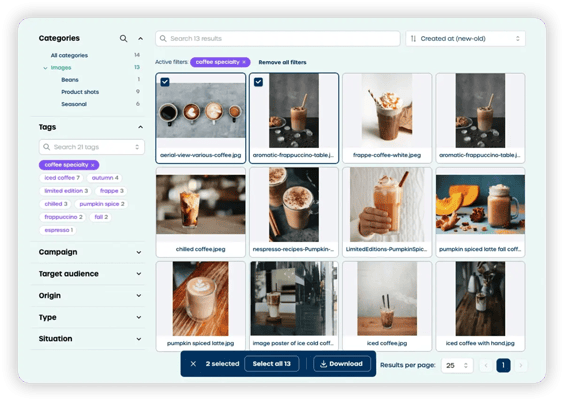
Centralized content management gives the central team one place to manage approved marketing assets, templates, messaging, and permissions. That matters because scattered files create scattered execution.
When materials are spread across email threads, shared drives, personal folders, and outdated campaign kits, local teams can't easily tell which version is current. That creates duplicate work, inconsistent campaigns, and lower adoption of approved assets.
A centralized approach helps teams:
-
Keep one current version of each approved asset.
-
Organize materials by campaign, channel, region, or audience.
-
Control who can access, edit, or distribute content.
-
Retire outdated materials quickly.
-
Give local teams an easier path to using on-brand assets.
In practice, centralized content management removes friction for both sides. The central team gets better control over what enters the field, and local teams spend less time searching, asking, and waiting.
Why templates are one of the best tools for brand flexibility
Templates are one of the most practical ways to support brand flexibility without giving up control.
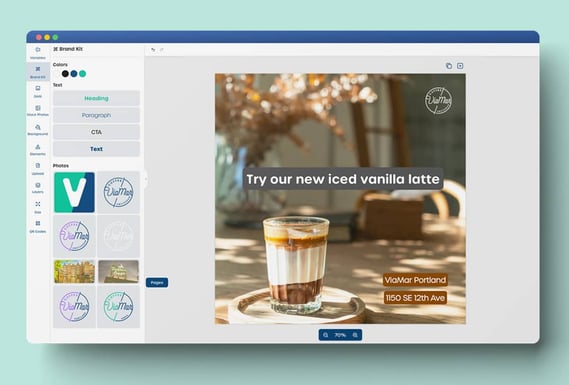
A useful template locks the parts of an asset that should stay consistent and opens only the fields local teams actually need to customize. That could mean a social post template with fixed branding and editable offer text, or a flyer with locked layout elements and editable store information. This is where localization of marketing materials becomes manageable, because local teams are customizing inside approved limits instead of creating new materials from scratch.
This matters because most local customization does not require full creative freedom. It requires clear flexibility inside approved boundaries.
For example, a central team might build:
-
A direct mail template with fixed brand design and editable local contact details.
-
A paid social template with approved imagery and customizable headline variations.
-
An event poster template with locked logo placement and editable event fields.
-
An email template with approved structure and location-level content blocks.
When templates are built around real usage, local teams can customize materials on their own without starting from scratch or sending every request back to headquarters.
How approval workflows support brand governance at scale
Templates solve a large part of the problem, but not every asset should go live without review. That is where approval workflows matter.
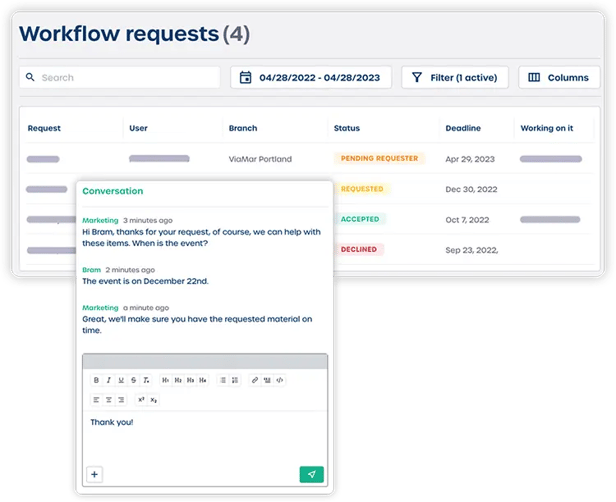
An approval workflow lets the central team decide which materials can be customized freely, which need review before use, and which changes are not allowed at all. That makes the process practical instead of rigid.
For example:
-
Routine edits to contact details may not need approval.
-
Changes to pricing or regulated language may require approval.
-
Edits to locked campaign messaging may be blocked completely.
This structure supports speed where speed is safe, and review where review is necessary.
It also gives the central team more visibility. They can see what local teams are using, which requests keep coming back, and where approval bottlenecks are happening. Over time, that makes it easier to improve templates and reduce unnecessary review work.
What a balanced operating model looks like
The strongest multi-location marketing teams do not force a choice between control and flexibility. They build a workflow that separates fixed brand elements from approved customization.
A balanced model usually includes:
1. Clear brand guardrails. Define what local teams can and cannot change. Keep those rules specific to actual asset usage, not just high-level brand principles.
2. Approved templates for common use cases. Build templates around the materials local teams request most often, such as flyers, social posts, event assets, email campaigns, and local ads.
3. Role-based permissions. Give different users different levels of access. Some teams may only customize fields. Others may submit edits for approval. A smaller group may manage final approvals.
4. Workflow-based approvals. Use approvals selectively. If every minor edit requires central review, the same bottleneck comes back.
5. One source of truth for assets. Keep current materials in a centralized system so local teams know what to use and the central team knows what is active.
This kind of operating model supports local marketing at scale because it treats brand consistency as a workflow design problem. It also gives the central team a more practical way to manage brand governance, centralized content management, and marketing asset management together instead of as separate tasks.
Common mistakes that make the balance harder to maintain
Even teams with strong brand standards can create friction when the process is not built around real usage.
One common mistake is locking down too much. If local teams cannot make practical updates on their own, they either stop using the approved materials or send everything back to the central team.
Another is allowing too much freedom in the name of speed. That may solve a short-term execution issue, but it usually leads to inconsistent messaging, mismatched visuals, and more cleanup later.
A third is treating templates as static files instead of part of a larger system. A template only helps when people can find it, use it correctly, and move it through the right approval path.
The teams that improve fastest usually keep asking the same question: which requests are truly custom, and which ones should become self-service template options instead?
How to improve brand consistency without slowing local teams down
If your team is trying to improve brand consistency across locations, start with the requests that take up the most time.
Look at which materials local teams ask to customize again and again. Look at which edits are low risk. Look at which approvals happen so often that they probably belong in the template system instead.
That gives you a practical place to start. Rather than rebuilding the whole process at once, begin with a few high-volume asset types and define:
-
What stays locked.
-
What local teams can customize.
-
What needs approval.
-
Who can publish or distribute the final asset.
Once that structure is in place, you can expand it across more campaigns and channels.
For central franchise marketing teams, this usually leads to better adoption of approved materials, fewer repetitive requests, and a faster path from campaign creation to local execution.

Where software fits into the process
At a certain scale, manual coordination becomes the limiting factor. Spreadsheets, email approvals, and shared folders can work for a while, but they usually break down as the number of locations, users, and asset variations grows.
That is where a brand-to-local marketing platform becomes useful.
With Marvia, central teams can manage approved assets in one place, create templates that support controlled customization, and set up approval workflows that match how local marketing actually works. Local teams get more freedom to use and customize materials, while the central team keeps campaigns on-brand across every location.
The value is not just tighter control. It is giving local teams a practical way to move faster without creating more manual work for headquarters.
Ready to give local teams more flexibility without losing brand control?