
Ask franchisors what keeps franchisees from using the marketing materials HQ creates, and slow approvals comes out on top. In the 2026 Franchise Marketing Insights Survey, franchisor-side respondents picked their two biggest bottlenecks, and "approval process is too slow" drew 27% of all selections. That's ahead of franchisees not knowing materials exist (21%), franchisees preferring to make their own (21%), and materials that don't fit the local market (18%).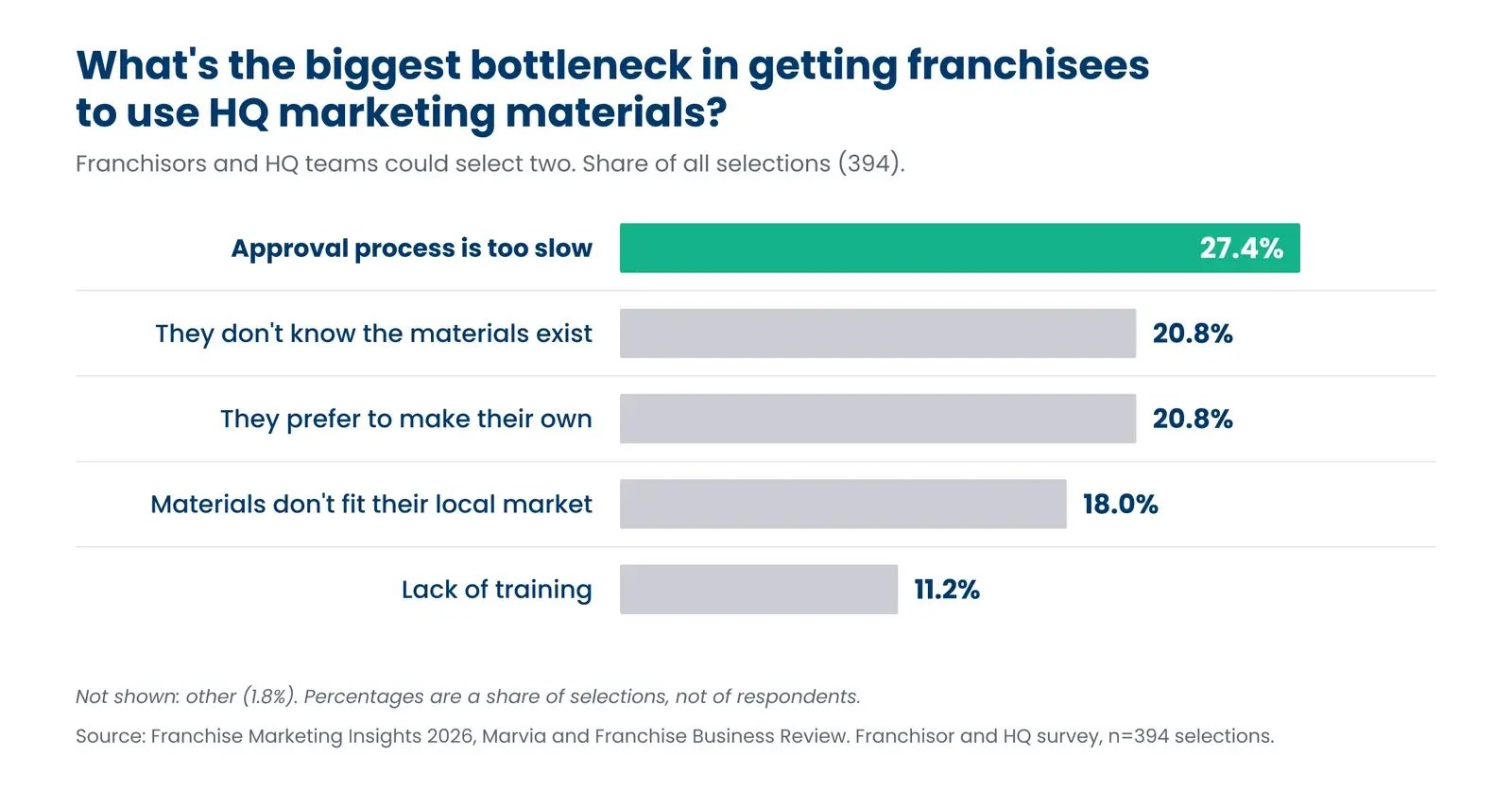
So franchisors know approvals are a problem. Here's the surprising part.
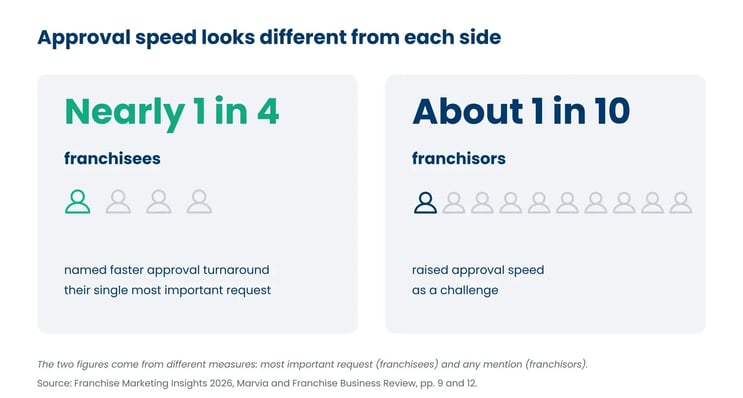
When the report compared what each respondent group raised on its own, approval speed was the issue where franchisors and franchisees sat furthest apart. Franchisees named it as a top concern, and nearly a quarter called faster approval turnaround their single most important request. Suppliers, who work across many brands at once, flagged it as a real bottleneck too. But only about 1 in 10 franchisors brought it up.
How do franchisees experience approval delays?
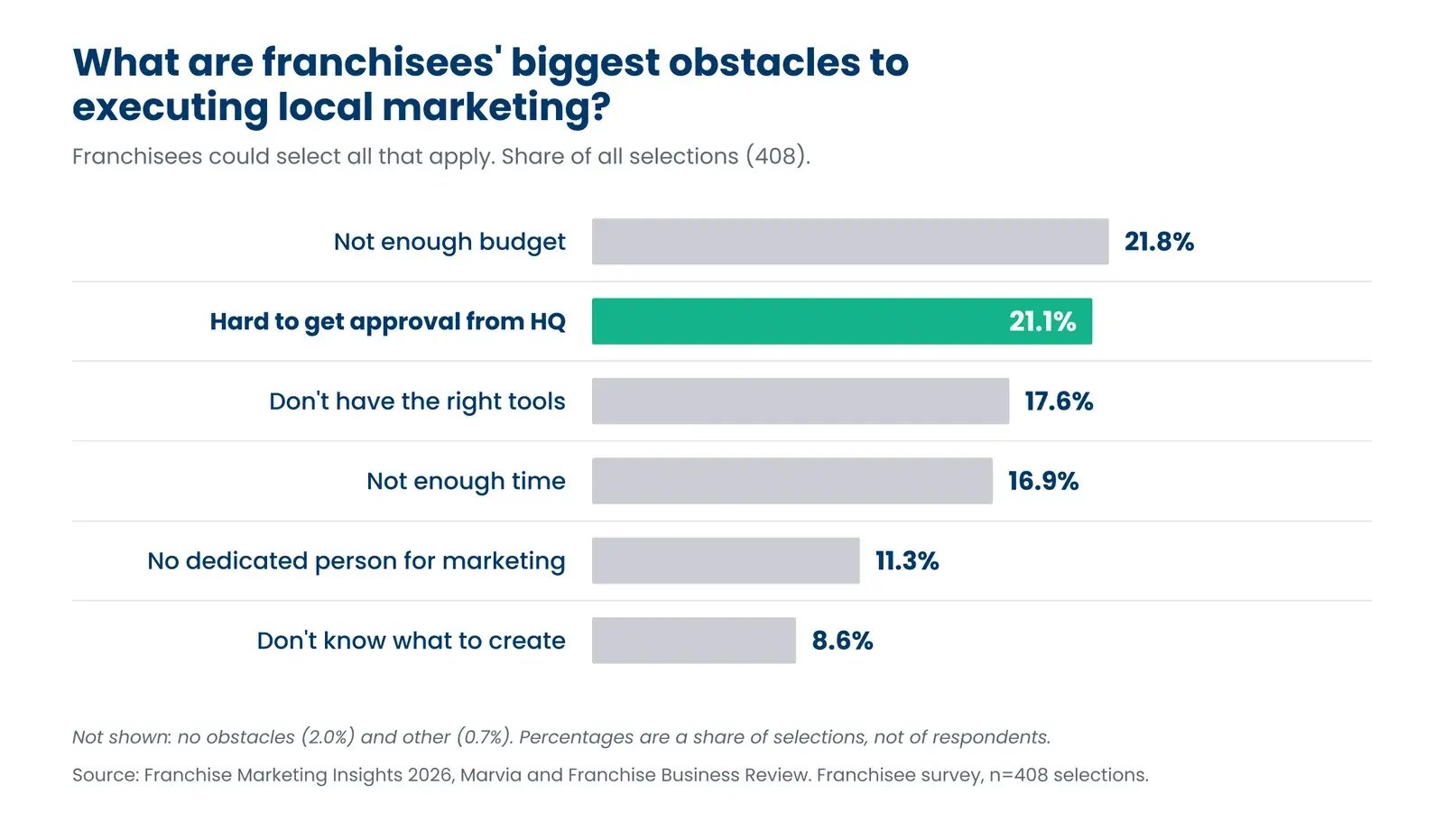
For franchisees, approvals sit right at the top of the list of things getting in the way. "Hard to get approval from HQ" drew 21% of franchisee selections for biggest local marketing obstacle, nearly tied with budget at 22%. And 25% of franchisees say they've created their own marketing content because they couldn't get approval fast enough.
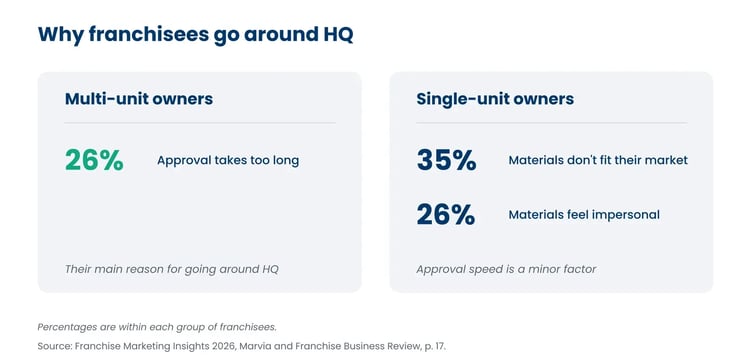
The pressure isn't spread evenly, either. According to the report, multi-unit owners go around HQ mainly because approval takes too long (26%), while single-unit owners rarely cite approval speed as their reason. Franchisees with 10 or more years in their system also bypass HQ deliberately, with slow approvals as one of their two main reasons.
Those are some of the most experienced, most invested operators in a system. They're the ones feeling this most.
Why do franchisors overlook approval speed?
The report puts it plainly: the people living with a slow process can't change it, and the people who control it don't feel it the same way. However, I'd go a step further.
From where HQ sits, an approval is a request in a queue. It gets reviewed, it gets a reply, and the work moves on. Nothing about that feels broken. From where the franchisee sits, the same request might be a sponsorship banner for Saturday's youth soccer tournament or a response to a competitor's promo down the street. If the answer comes Tuesday, the moment's gone. The report captures this well: a national campaign that launches perfectly on a Tuesday is worth less than a local promotion that catches a Saturday opportunity.
That's why I think approval speed slips off the franchisor priority list. It reads as operations, and the strategic conversations at HQ are about AI and data, which the report shows are among franchisors' most-cited priorities for the year ahead. Approval turnaround rarely shows up on a dashboard. Missed local moments don't show up anywhere.
There's a second reason this deserves more attention. A review queue gets slower as a system grows, because every new location adds requests to the same small team. And when franchisees give up waiting and build their own version, they create exactly the brand risk the approval process was designed to prevent. The report makes that point too, and it's the part that should worry brand teams most.
My biggest takeaway is that most approval requests are a signal. Each one marks a moment where a franchisee needed something the approved materials didn't let them do on their own, like add a local partner's logo, swap in a different offer, or use a photo of their actual team. Speeding up reviewers helps. Reducing how often a franchisee needs a reviewer helps a lot more.
How can franchise brands speed up marketing approvals?
The report's recommendation is to replace manual approvals with pre-approved frameworks wherever possible. Here's how I'd put that advice to work.
-
Measure turnaround like a service. Track the time from request to answer, by content type. Then share a target with franchisees, like same-day for social posts and two business days for new creative. A visible standard turns a vague frustration into something both sides can manage.
- Sort requests into lanes. Many franchise systems run every request through one review process. A three-lane setup moves the routine work out of the queue:
-
Measure turnaround like a service. Track the time from request to answer, by content type. Then share a target with franchisees, like same-day for social posts and two business days for new creative. A visible standard turns a vague frustration into something both sides can manage.
-
Sort requests into lanes. Many franchise systems run every request through one review process. A three-lane setup moves the routine work out of the queue:
| Lane | What goes here | Review needed |
|---|---|---|
| Pre-approved | Template edits inside unlocked fields: city, date, local offer, photo from the approved library | None |
| Quick check | Local photos, a partner logo, a new offer that fits existing guidelines | Light review with a fast turnaround target |
| Full review | Pricing claims, legal or regulated language, brand-new creative | Standard review |
In most systems, I'd expect the first lane to cover the bulk of everyday local marketing.
-
Build approval into the template. Lock what has to stay consistent, like the logo, colors, fonts, and legal copy. Open up what local teams actually need to customize. When the guardrails live inside the template, a franchisee who customizes it is already on-brand, so there's nothing left to approve.
-
Turn repeat requests into new templates. Review approval requests monthly and look for patterns. If 15 locations asked to add a local sponsor's logo last quarter, that's a template your system is missing. Every recurring request you convert is one fewer request next month.
-
Give proven operators more room. The report's closing recommendations include giving experienced, proven operators more latitude within brand guardrails. Because multi-unit and long-tenured franchisees feel approval delays most, consider a faster lane for operators with a strong track record of on-brand work.
How pre-approved templates work in practice
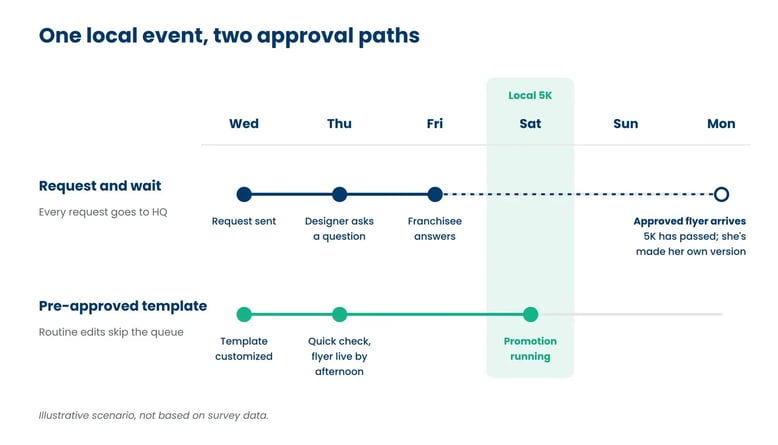
Picture a multi-unit owner at a fitness franchise. A local 5K is happening Saturday, and she wants to offer runners a free recovery class at her three nearby studios.
In a request-and-wait system, she emails HQ on Wednesday. The request lands in a queue behind dozens of others. A designer asks a question Thursday, she answers Friday, and the approved flyer arrives Monday. By then she's already made her own version in a free design app, with a stretched logo and the wrong font. Everybody's frustrated, and nobody did anything wrong.
Now run it through lanes. She opens the brand's pre-approved event template, types in the race name and date, picks a photo from the approved library, and selects her three studios. The logo, colors, and legal copy are locked, so the flyer is on-brand the moment she finishes. She wants to add the race organizer's logo, which bumps it into the quick-check lane, and a reviewer signs off within a few hours. It's live Thursday afternoon.
Back at HQ, the marketing team sees which locations used the template and what they changed. At the end of the month, they notice a dozen locations asked to add a partner logo. So they add an optional partner logo field to the event template, and next month, those requests disappear from the queue.
Platforms built for franchise marketing are designed around this kind of setup. In Marvia, for example, brand teams decide which template fields are locked and which local teams can customize, and anything outside those fields goes through an approval workflow, so routine work skips the queue and the exceptions still get a review.
Make the approved path the path of least resistance
Franchisors already know slow approvals hold local marketing back. The data says so. What's missing is urgency, because the cost lands on franchisees, one missed Saturday at a time.
The good news is that this is one of the most fixable problems in franchise marketing. Pre-approved templates, clear review lanes, and a habit of turning repeat requests into new templates can take a lot of pressure off the queue. When the approved route is also the quickest one, franchisees take it.
For the full picture, download your copy of the Franchise Marketing Insights 2026 report.