
Do franchisors and franchisees agree on franchisee marketing autonomy?
Franchisors say: "Our franchisees have room to move within the guidelines."
Franchisees say: "I need more room to adapt to my market."
Suppliers say: "National strategy doesn't match local reality."
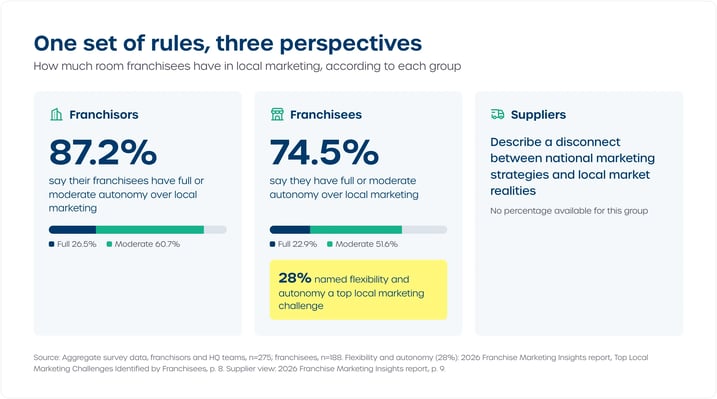
That's one set of rules, seen from three different perspectives. For most franchisors, autonomy looks settled: 87.2% say their franchisees have full or moderate freedom over local marketing. Franchisees are more likely to bump into the edges. Only 74.5% say they have full or moderate autonomy, and 28% named flexibility and autonomy as one of their top local marketing challenges. Suppliers work across many systems at once, and they describe a wider disconnect between national marketing strategies and local market realities. I think the space between those views shows exactly where local marketing gets stuck.
How much control do franchisees have over local marketing?
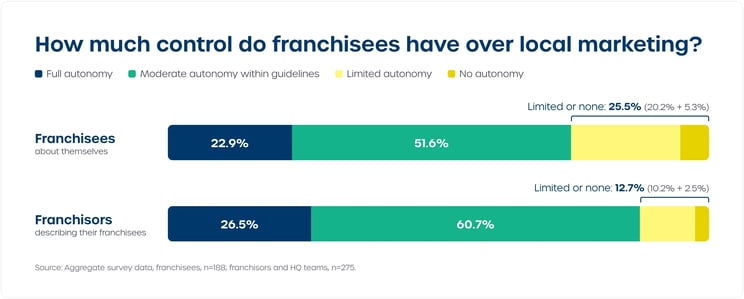
Most franchisees have a meaningful amount of control, but a sizable minority don't. In the 2026 Franchise Marketing Insights survey from Marvia and Franchise Business Review, here's how franchisees described their autonomy over local marketing:
-
Full autonomy: 22.9%
-
Moderate autonomy within guidelines: 51.6%
-
Limited autonomy: 20.2%
-
No autonomy: 5.3%
We asked franchisors the same question about their franchisees. Their answers were noticeably more generous:
-
Full autonomy: 26.5%
-
Moderate: 60.7%
-
Limited: 10.2%
-
None: 2.5%
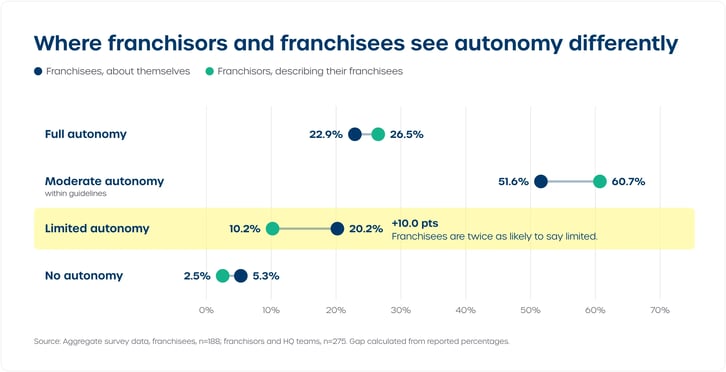
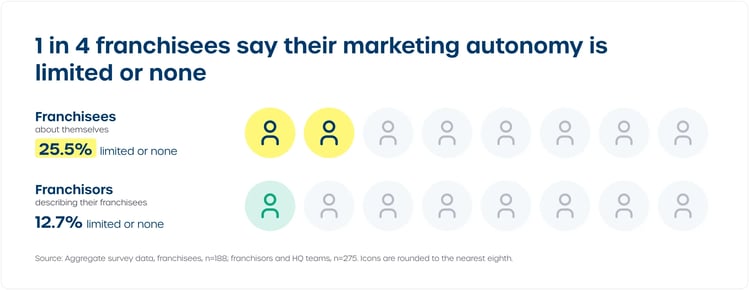
Here's the part I find most interesting. Both groups agree almost exactly on how many franchisees have full autonomy. The difference sits lower down. Franchisees are twice as likely as franchisors to put themselves in the "limited" bucket (20.2% vs. 10.2%), and about 1 in 4 franchisees say their autonomy is limited or nonexistent, compared with roughly 1 in 8 franchisors.
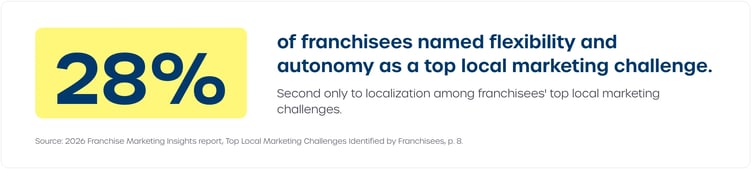
The open-ended answers point the same way. When franchisees named their top local marketing challenges, 28% pointed to flexibility and autonomy, second only to localization (report, p. 8). Many described one-size-fits-all solutions that don't fit their market. They weren't asking to throw out brand standards, though. What they described wanting was better templates with enough room to adapt to their community (report, p. 9).
Why do franchisors see more marketing freedom than franchisees feel?
I think both groups are describing the same rules and living with very different versions of them.
From HQ, "moderate autonomy within guidelines" sounds like a fair deal. Franchisees get a brand book, a library of templates, and permission to customize within the lines. On paper, that's a lot of freedom.
From the location, the question is whether that freedom is usable on a Tuesday afternoon. If the template doesn't have a field for the local promo, it isn't really editable. If a small change needs sign-off and sign-off takes a week, the event it was for has already passed. The report describes franchisees spending hours building graphics from scratch because corporate assets are either too generic or too locked down to be useful (p. 8). It also found that franchisees ranked approval speed as one of their top three concerns, while franchisors registered it at roughly half that rate (p. 21).
So when a franchisee picks "limited autonomy," I don't read that as a complaint about the guidelines themselves. I read it as a report on how much room is left once the templates, tools, and approval steps are factored in.
There's also a second layer worth discussing. The report found that tenured franchisees are more likely than newer owners to build marketing outside official channels, and they do it deliberately, because materials don't fit their market or approvals are too slow (p. 15). Those are often a system's strongest operators. When the people who know their market best feel boxed in, HQ should treat that as feedback on how the system is built.
How much marketing control should franchisees have?
Enough to make the marketing genuinely local, with the brand-critical pieces fixed in place. The report's name for this is structured trust: autonomy with brand guardrails that give experienced, proven operators latitude within their market (p. 24). Here's how I'd put that into practice.
-
Decide what's locked and what's open, element by element. Most franchise local marketing guidelines describe the brand. Fewer spell out what a location can change. Lock the things that make you recognizable, like the logo, color palette, typography, and required legal copy. Open the things only the location knows: the town name, local photos, the promo, the event date, the community partner. The report recommends building templates with editable fields for market, season, and promotion from the start, so localization isn't a special request (p. 21).
-
Pre-approve the common variations. If franchisees ask for the same five kinds of changes every month, approve those five once. The report suggests replacing manual approvals with pre-approved templates, standardized campaign variations, and clear guardrails, since a review queue only gets slower as the system grows (p. 21). Save human review for the genuinely new stuff.
-
Give proven operators more room. Autonomy doesn't have to be one setting for the whole system. A multi-unit owner with ten years in the brand and a clean compliance record can reasonably get wider latitude than someone in their first six months. The newer owner usually needs more ready-to-use campaigns, and the report notes that single-unit operators in particular get outsized value from simplified execution (p. 16).
-
Ask franchisees the autonomy question yourself. You can't fix a perception gap you haven't measured. Put the same question to your franchisees and your HQ team, then compare. If your franchisees' "limited" share looks like the 20.2% in this survey while HQ's looks like 10.2%, you've found where to start.
What does structured trust look like in practice?
One franchisee in the survey described exactly what they wanted:
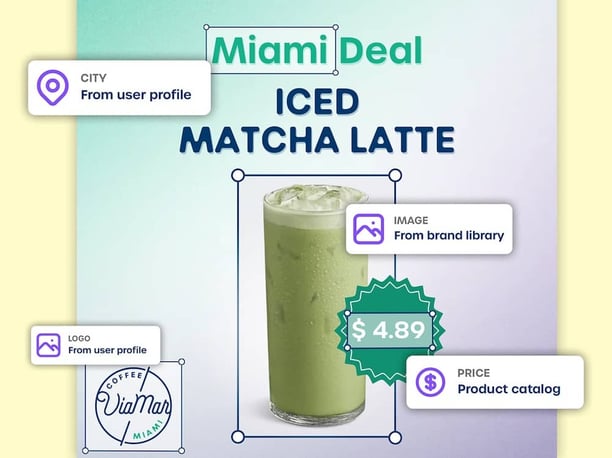
"Give me ready-to-post local content templates with editable fields for city, promos, and photos. Right now I spend hours making graphics from scratch." — Franchisee, report p. 8
Picture a fitness franchise location that's sponsoring a charity 5K on Saturday. It's Wednesday. Under a review-everything model, the owner either sends a custom request and hopes it clears in time, or opens a design app and builds something off-brand. Neither is great.
With structured trust, the owner opens a pre-approved event template. The logo, colors, fonts, and legal line are locked. The headline, date, photo, and partner name are open. They drop in a shot from last year's race, add the details, and post it the same afternoon. No approval needed, because HQ already approved the template and decided which fields can change.
Now say the owner wants something the template doesn't cover, like a co-branded flyer with a local gym partner. That goes to review, because it's genuinely new. The approval queue gets shorter because it only holds the requests that need a human.
This is the setup we build for in Marvia: brand teams decide which template fields are locked and which are editable, set approval rules only where they're needed, and see which templates locations actually use. That last part matters more than it sounds. Usage data shows you where franchisees are hitting the edges of their autonomy, so you can open up the next template before they go around it.
Franchisee marketing autonomy works best when it's built into the tools
So, how much control do franchisees have over local marketing? Most have a fair amount. About 3 in 4 franchisees in the 2026 Franchise Marketing Insights survey said they have full or moderate autonomy. But 1 in 4 said limited or none, about double the share franchisors reported.
I don't think closing that gap means loosening brand standards. It means making the freedom you've already granted easy to use: templates with the right fields open, approvals that only catch what's new, and more room for the operators who've earned it. Get that right, and the guidelines start working for franchisees instead of around them.
This post covers just one question. For the full picture, download your copy of the Franchise Marketing Insights 2026 report. It dives deeper into the five friction points franchisees say hold back local marketing and the four priorities (structured trust is one of them) that the report recommends to franchise leaders.