
Key takeaways
126 agencies, 37 states
On-brand while state rules decide what local marketing can say
Lock what's required
Logo, colors, tagline, state licensing details, and signature programs
Freedom by experience
Ready-made templates for new owners, Flex Studio for seasoned ones
The AI challenge
Getting owners to use the hub instead of ChatGPT or Canva
In most franchise systems, the brand book decides what local marketing looks like. In home care, the state has a say too. Some states require specific licensing details on every piece of marketing, some restrict how certain services can be described, and the rules can change months before an agency opens.
HomeWell Care Services deals with this every day. The brand has about 126 agencies open, 141 locations sold, and operates in 37 states and 262 territories. We sat down with Mishelle Payne, Senior Vice President of Marketing at HomeWell Franchising, the franchisor for HomeWell Care Services, to unpack how her team keeps every agency on-brand and compliant, without taking away the freedom owners need to market locally.
Learn More
Why is home care marketing different?
Mishelle came to HomeWell from hotel franchising, where brand standards are very prescriptive: the same signage, the same collateral, the same promotions everywhere. Home care works differently.
HomeWell owners offer a similar set of non-medical in-home care services, but not all of them. Some offer transportation; others don't. Some focus on payer sources like the VA or Medicaid; others on private pay. On top of that, each state adds its own layer. Some require a registered nurse on staff before an agency can open. Others are particular about the wording used to describe certain services.
"Our marketing needs are never one size fits all for our franchise system," Mishelle said. "What works for one owner in one market may not work for another in the next state, or even a couple of territories away."
How far that can go became clear earlier this year. A few months before one owner was set to open, their state changed its regulations and became much more restrictive. The new owner wasn't allowed to say about half of what HomeWell normally says in its marketing, including its signature programs. The team had to delete about two-thirds of the agency's website and rewrite the rest to get the agency approved to open.
Where do you draw the line between control and flexibility?
HomeWell's answer: lock what's required, and give owners room on the rest.
Locked by the brand:
- Logos, colors, tagline, and fonts
- State licensing details, which fill in automatically for the state the agency is in
- Signature programs, because they're key differentiators for the brand
Up to the owner:
- Agency details
- Photos
- Service bullet points, for example, the three things an owner specializes in for companion care
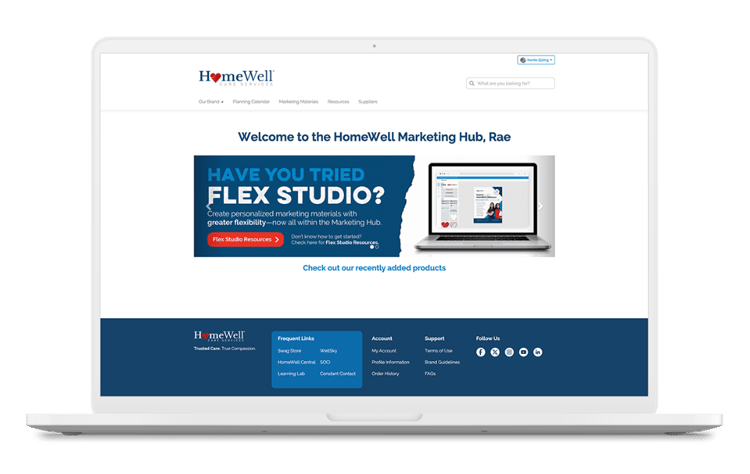
How much freedom an owner gets also depends on their experience. Newer owners, who are still learning the brand and their local audiences, use ready-made, on-brand templates. They add their agency details, maybe change a photo or a few bullet points, and they're done. Seasoned owners can use Flex Studio, HomeWell's name for its flexible templates, to adjust layouts, move elements, and tailor content to their market.
What HomeWell doesn't offer is a blank slate. The team tested it and found it was too open. Flex Studio templates now start with suggested content to get owners going.
"Our franchisees have a lot of entrepreneurial spirit in them, and we don't necessarily want to squash that," Mishelle said. "But we do want to put enough bumpers to keep them from going off the cliff."
A brand that evolves with its owners
When Mishelle joined in 2019, HomeWell was in the middle of a rebrand. HomeWell Senior Care became HomeWell Care Services because the brand provides care for anyone who needs help at home, not only seniors. The team redesigned the logo, set new brand guidelines, and chose a look that stands out in home care.
Before that, it was "kind of the wild west" with marketing: editable PDFs floating around and no version control. HomeWell launched its first marketing hub alongside the rebrand in 2019, moved to a new hub built on Marvia in 2024, and added Flex Studio in 2026.
"Your brand should be a living and breathing asset that evolves along with you and your growth," Mishelle said. "We're always looking to improve the brand and the tools and resources we provide to our owners."
How do you meet owners where they are?
HomeWell uses its hub to give owners what fits their stage of business, so they don't have to search for it:
- A new owner and grand opening collection with all the pieces HomeWell recommends for an opening, alongside a new owner checklist and launch training
- Digital brand guidelines, connected to the logos and other assets owners download from the DAM
- A planning calendar with what to talk about on social media each month, including industry awareness days, with the recommended assets linked
- Request forms for things owners can't find, such as a local ad the marketing team designs for them
Requests and feedback from owners, field teams, and surveys go to Mishelle's team. If an idea could be useful for the whole system, it goes into the design queue.
How do you get owners to use the hub instead of ChatGPT or Canva?
This is HomeWell's biggest challenge right now. Mishelle calls AI her "nemesis" in the branding world: assets made in ChatGPT or Canva aren't brand compliant, and owners are used to those tools.
"I would rather see them exploring the Flex Studio tool and making design mistakes there than trying to build something in ChatGPT or Canva, where we know those assets absolutely won't be brand compliant," she said.
What works for HomeWell:
- Start early. New owners learn the hub as part of their launch training, so it becomes the place they go from day one. Legacy owners with their own habits are harder to win over.
- Use the data. The marketing team works with HomeWell's franchise business consultants and looks at usage reporting. If an owner hasn't been on the hub in a while, that's a reason to talk about what they're doing for local marketing.
- Carrot first. "We really prefer to use the carrot versus the stick method," Mishelle said. Masterminds, regional meetings and conferences create a bit of FOMO: owners see a great resource and want to find it themselves. Flex Studio, which owners had asked for, is one of those carrots.
- Make it personal. When Flex Studio launched, interest was decent but regular use was slow. The team held its first workshop, with about 100 registrations and around 60 owners attending live. "We're in a people business," Mishelle said. Owners would rather join a 30-minute workshop than read a page with how-to videos, because they want to ask questions.
What changed for the central team?
About five years ago, Mishelle's team was getting requests for individual flyers all the time. "It's not really sustainable," she said.
With Flex Studio, owners can adapt a template themselves, so requests for things like local ads are becoming less frequent. The team also builds the open-ended Flex Studio templates faster than the traditional fixed templates. That gives Mishelle's team of eight more time for larger initiatives that, in her words, "deliver greater impact to our franchise system than 100 flyers ever would."
What can other franchise marketers learn from HomeWell?
"You really just have to evaluate what makes sense for your industry and your franchise system," Mishelle advised. For HomeWell, the need for flexibility was clear: "We couldn't possibly build out every single asset to meet the needs of every single owner. Or if we could, it would take forever, or I would have to add a lot more headcount."
And whatever you build, build it with your owners. "It's one thing to listen to them," Mishelle said. "But it's another thing if we can actually deliver on something that's a direct result of what they ask for."
The takeaway? Lock what has to be right, like state licensing and signature programs, and give owners guided freedom on the rest. That keeps the brand consistent and compliant, and keeps owners using the tools you give them.
Learn from franchise marketing leaders
This is the second episode of Slice of Success, our series where franchise marketing leaders share what's actually working. Sign up to get notified about new episodes and learn from brands like Boston Pizza and HomeWell.
Want to see how Marvia helps home care brands keep every agency on-brand and compliant? Read the HomeWell customer story or learn more about our marketing platform for home care and senior living.