.png?width=300&name=OG%20local%20dealer%20store%20no%20ads%20(1).png)
Last updated: August 7, 2026
Ask most Channel Marketing Managers what their biggest dealer marketing problem is, and they will say something about brand consistency. Wrong logos. Off-message promotions. Dealers going rogue with their own materials.
It is a real problem. But it is usually the second problem. The one that costs more and gets talked about less is that most dealers are not marketing the brand locally at all.
Not inconsistently. Not badly. Just not.
The majority of the manufacturers we speak to have fewer than 30% of their dealers actively using HQ materials in any given quarter. The rest are either doing their own thing or doing nothing. If that sounds familiar, the issue is almost certainly not the quality of your materials. It is how easy they are to find, use, and make relevant to a dealer's local market.
The activation gap nobody is measuring
Central marketing teams measure what they can see. Assets downloaded. Portal logins. Emails opened. What they cannot easily see is the 70% of the network that never logged in, never downloaded anything, and never ran a local campaign with HQ materials this quarter.
That gap does not show up as a problem in most reporting. It shows up as your brand being invisible in markets where you have dealers, because those dealers are simply not marketing you. The manufacturers with high dealer activation rates are not producing better creative or running bigger budgets. They have made local activation easier. That is the whole difference.
Quick check
How many of your dealers marketed your brand last quarter?
Five questions. Two minutes.
A clearer picture of where your dealer activation is breaking down.
What high-activation networks do differently
They make materials ready to use, not ready to be worked on. In low-activation networks, assets arrive as master files that need a designer, or templates so locked down that adding a local address requires a request back to HQ. In high-activation networks, a dealer can log in, find what they need, make the adjustments they are allowed to make, and have something ready to use in a few minutes. The template does the work. The dealer fills in their details.
They build the library for the dealer, not themselves. An asset library organised by campaign year and product category makes sense internally. It does not make sense to a dealer who logs in twice a year looking for something specific. High-activation networks organise around how dealers actually search: by product, by season, by format. Finding the right thing takes seconds rather than a frustrated browse through nested folders.
They build local relevance in from the start. A generic national campaign asset is not always usable at a local level. Dealers need to add their own store details, a local offer, sometimes adapt the language. If that customisation requires going back to HQ, many dealers will not bother. High-activation networks build local flexibility into the template from the beginning, within brand guardrails but genuinely flexible where it matters.
They tell dealers what to do with it. Sending an asset pack is not activating a dealer. High-activation networks send specific, timely prompts: here is what is available right now, here is what it looks like, here is how to use it. Not a monthly newsletter. A direct nudge tied to a campaign moment that makes the next step obvious.

What this looks like when it works
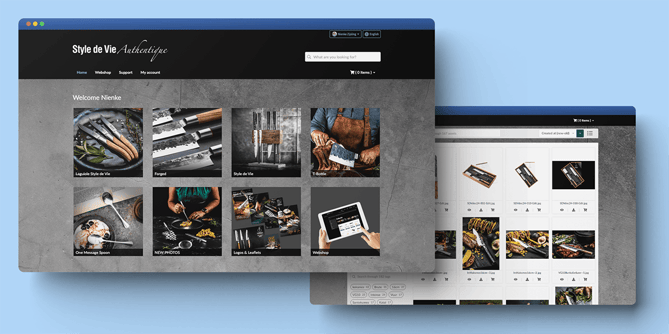
Style de Vie had over 2,400 marketing assets to share with a growing reseller network across Benelux. Emailing files and fielding individual requests was not scaling. They built a branded portal where resellers could find campaign materials, product imagery, and logos independently and without needing to contact HQ. Reseller activation went up. Not because the materials got better, but because getting to them got easier.
Moving dealers from passive to active
If your activation rate is low, the fix is rarely a new campaign. It is a closer look at the experience a dealer has when they try to use your materials.
Start with the friction. Pick five dealers who have not used HQ materials in the last six months and find out why. Not with a survey but with a conversation. The answers are almost always about access, format, or relevance. Rarely about motivation.
Then look at your most active dealers. What do they have in common? Often someone showed them the portal once, walked them through it, and gave them a reason to come back. That experience is replicable.
Full activation across an independent dealer network is not a realistic goal. But moving from 25% to 45% active dealers has a real commercial impact. More of your brand showing up locally. More points of sale where your product is being actively marketed. That is the lever most manufacturers have not pulled yet.
Overcoming Distributed Marketing Bottlenecks
Read how leading franchise networks coordinate corporate campaign strategy with local market execution without losing brand control.
Read the Franchise Strategy ChapterQuestions to take back internally
-
What percentage of your dealers used HQ materials last quarter? If you do not know, that is itself useful information.
-
How long does it take a dealer to find the right asset, adapt it, and have something ready to use? Time it yourself.
-
When did you last proactively tell your dealers what was available? Not in a newsletter but in a specific, timely prompt tied to a campaign moment.
-
What do your most active dealers have in common? And what would it take to give that experience to the rest of the network?
A useful starting point
The most useful thing you can do right now is pick one of the five reasons above and ask honestly whether it applies to your network. Not in theory. In practice.
Can a dealer find what they need in under a minute? Are your assets in formats they can actually open and use without specialist software? How many steps does it take to customise a template and get it ready to use locally? When did you last give dealers a specific, timely reason to come back to the portal rather than a monthly newsletter they ignored? Those are not complicated questions. But the answers tend to be more revealing than a dealer survey.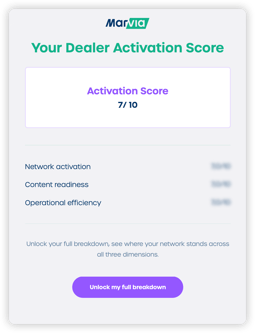
If some of them are hard to answer, that is a useful signal in itself.
Our dealer activation score quiz works through exactly these questions and gives you a quick, structured picture of where your dealer marketing is breaking down and where the biggest opportunities to improve activation sit.